
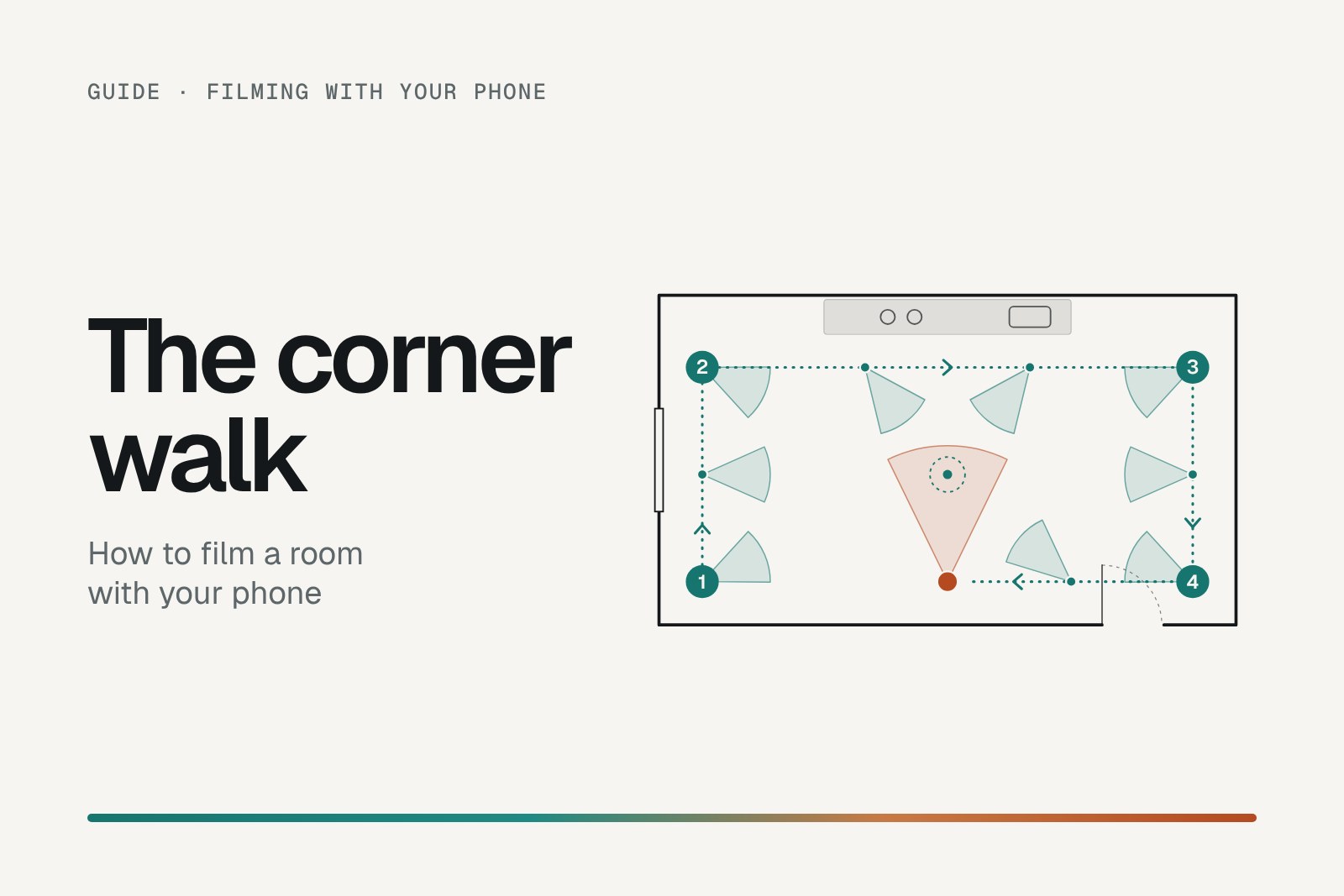
In short: start in a corner, with your back to the wall. Walk slowly along the walls with the phone in landscape, 1.30 m off the floor (down to 1 m in the bathroom) and always pointed at the centre of the room. Go all the way round, then stop straight in front of what matters: the kitchen, the bed, the bathtub. Before you start: lights on, curtains open, room tidy. 30–60 seconds is enough for a room.
Why do rooms look small in phone videos?
Almost always because of one habit: whoever is filming stands in the middle of the room and spins round. From there every wall is two steps away and the phone sees one at a time. The room arrives in pieces, the lines bend and no shot shows how big it is. Fine for WhatsApp, not for a listing.
An interior photographer does the opposite. They stand in a corner, back to the wall, and look towards the centre. From there they see two walls, the floor running all the way to the far side, the light from the window: the same room, finally readable.
✕ From the centreOne wall at a time, two steps away.
✓ From the cornerTwo walls and the full depth.
The 30-second test
No need to take our word for it. Pick up your phone and go to the nearest room.
- Stand in the middle and take a photo.
- Go to a corner, put your back against the wall and take another one, with the phone straight at chest height.
- Put them side by side.
The second one shows more room: two walls instead of one, and the depth all the way to the opposite wall. You didn't change phone or light: only where you stood. The rest of this guide grows from there.
What photographers do: we counted
We took professional shoots from our archive and looked at where every photo was taken from.
- 56% from a corner. Even in bathrooms, where space is tight: 68%.
- 25% straight on, squarely facing a wall. In hallways it rises to 68%.
- 9% at an angle and 6% details. The rest is negligible.
- At chest height 87% of the time. And in nine photos out of ten the verticals are off by less than a degree: to the eye, perfectly straight.
The rules that follow come from there.
The corner walk, step by step
Think of the room as a theatre: you are the audience, not the actor. The audience sits at the edges and watches the centre.
- Start in a corner, with your back to the wall.
- Walk slowly along the walls, with the phone always pointed at the centre of the room, as if there were something there you mustn't lose sight of.
- Go all the way round, one corner after another, without stopping. In the corners, slow down and turn with your whole body, not your wrist.
- Finish with a straight-on pause in front of what matters: the kitchen, the bed, the bathtub. It's the room's portrait.
30–60 seconds is enough for a room.
Why the walk works
- Every shot holds the room. From the edge the phone faces the full depth: two walls, the floor, the window. From the centre it would face one wall, too close.
- You can see the depth. When you move sideways, nearby things slide past faster than distant ones: that is how the eye understands how deep a room is. If you spin on the spot, everything moves together, like a postcard turning.
- The final pause says what room it is. Facing the kitchen or at the foot of the bed, straight on: it's the shot house hunters recognise at a glance.
How high should you hold the phone?
1.30 m off the floor. Use a door handle as your reference: a hand and a half above it. No tape measure? Chest height if you are under 1.75 m, stomach height if you are taller.
Why there? In Italy, rooms in a home are normally 2.70 m high: at 1.30 m you are almost halfway, and the phone shows floor and ceiling in proportion. Higher up you see too much floor, as if from above; lower down the furniture hides the room. It is also the height interior photographers work at, between 1.20 and 1.50 m. Keep it there for the whole walk.
One exception: rooms where everything sits low, like the bathroom, with its toilet, bathtub and shower. There you can go down to 1 m, at door-handle height, instead of tilting the phone towards the floor: everything fits in and the walls stay straight.
Phone straight, always in landscape
- In landscape. Cover images in search results and listing galleries are landscape: portrait footage gets cropped or shrunk.
- Straight ahead, neither at the floor nor at the ceiling. If you tilt the phone, corners, doors and windows lean and the room seems to fall over. Want more floor? Go lower. More ceiling? Go higher. Change the height, never the tilt.
- With the 0.5× ultra-wide lens, if your phone has one: in a small bedroom it makes the difference between seeing the bed and seeing the whole room. Does your phone have one?
The right pace: as if carrying a full tray
Walk slowly, as if you were carrying a tray of full glasses. Indoors there is less light than it seems: to see, the phone keeps each image open for longer, and every jolt becomes a smear. Slow steps, two hands on the phone, elbows close to your body: that's all the stability you need.
Before you press the red button
Two minutes of preparation are worth more than any retouching afterwards.
- Clean lens. A soft cloth, or your T-shirt, over the cameras on the back of the phone. A fingerprint makes everything hazy and the windows look like fog.
- Curtains open, lights on. All of them, even by day: the more light comes in, the truer the photo. You can film in the evening too: here's how.
- People and pets out. You too: watch out for mirrors.
- Tidy up. Away with bottles, towels, shoes and cables, documents and family photos. TV and monitors off, toilet seat down.
- Mirrors and glass. A mirror films you: walk past it at the side, without stopping in front. The same goes for glass walls and glossy cupboard doors.
Six mistakes that show at once
| Mistake | What you see | How to fix it |
|---|---|---|
| Standing in the middle, spinning round | Walls too close, bent lines, no depth | Along the walls, phone towards the centre |
| Phone in portrait | A strip of room, cropped in the listing | Always landscape |
| Phone tilted | Falling walls, too much floor or too much ceiling | Change height, not tilt |
| Walking fast | Blurred images, like a smear | The full-tray pace |
| Lights off, curtains closed | Dark room, muddy colours | Everything on, everything open |
| Standing in front of the mirror | You are in the shot, phone in hand | Walk past at the side, without stopping |
Where to make the final pause, room by room
| Room | Stop straight in front of |
|---|---|
| Kitchen | the worktop and the wall cupboards |
| Bedroom | the bed, from its foot |
| Bathroom | the washbasin, the bathtub or the shower |
| Living room | the main wall: the sofa, the bookcase or the fireplace |
| Hallway | the far end, centred: here the straight-on shot beats the walk |
After filming: which photos to put in the listing, and in what order.
And if you use Eskatta?
It's the same guide the app shows you the first time you film: eight animated steps, two minutes. It's always on the camera screen, under the «Guide» button.
Following it is the simplest way to get the best quality: no app can show a corner you never walked past. After upload, a free check tells you whether the video is fine or worth redoing.
The phone does its part. Your steps do the rest.
Create your account: 10 trial credits
From video to photos: how the agent's work changes.
Before you leave, check the final shot
In a bedroom, scrub through the video to the pause at the foot of the bed. If only the headboard is in frame, step back and film that pause again, keeping the phone level. Look for a view that shows the bed and the space to walk beside it.
Frequently asked questions
How long should the video of a room be?
Between 30 and 60 seconds: time to walk round along the walls at a slow pace and make the final pause in front of what matters.
Is it better to film in portrait or landscape?
Landscape. Listing covers and galleries are landscape: in portrait the room only fits in strips.
How high should you hold the phone to film a room?
1.30 m off the floor, a hand and a half above a door handle. Chest height if you are under 1.75 m, stomach height if you are taller. In the bathroom, where the toilet and bathtub sit low, you can go down to 1 m.
Is it better to stand in the middle of the room or in the corners?
In the corners and along the walls, with the phone towards the centre. From the middle you see one wall at a time, too close, and the room looks smaller.
Lights on or off?
On, all of them, with curtains and shutters open. You can film in the evening too.
Do you need the 0.5× ultra-wide lens?
It helps a lot, especially in small spaces, because it fits the whole room in. Check whether your phone has one.
How do you avoid appearing in mirrors?
Don't stop in front of them: walk past at the side. The same goes for glass walls and glossy cupboard doors.
Do you need a stabiliser?
It isn't essential. A slow pace, two hands on the phone and elbows close to your body already do most of the work.
Sources: Eskatta internal archive; Italian Ministry of Health decree, 5 July 1975, art. 1; HDRsoft, camera height for interiors.